

Residency in Mexico: The Pathways That Actually Matter
Residency is the part of a move to Mexico that people either overthink or dangerously underthink. Some assume it's impossibly complicated and hire a lawyer before they even understand the basics. Others assume they can just show up and figure it out later. Both are mistakes.
Here's the honest overview of how Mexican residency actually works, enough to understand your likely path and the traps most people miss.
First, understand what visitor status is not
A lot of people believe they can simply live in Mexico as a perpetual tourist, leaving and re-entering every few months. This is an unreliable strategy and it's getting riskier.
Visitor status is temporary and discretionary. You may be granted up to 180 days on entry, but that is a maximum, not a guarantee. Immigration officers have discretion and increasingly grant fewer days, and repeated long stays can attract scrutiny. Visitor status also gives you no work permission and no security. If Mexico is becoming your actual home, you want real residency, not a strategy that depends on a border officer's mood.
The main pathways
Mexico has several routes to residency. Most people focus on the money route without realizing others may fit them better.
- Economic Solvency. The most common path for retirees, remote workers, and financially independent people. You prove you can support yourself.
- Family Unity. Through a Mexican citizen or resident spouse, child, or parent. This can be stronger than the financial route and sometimes bypasses solvency requirements entirely.
- Student Residency. For those accepted into a qualifying Mexican school or program.
- Work-sponsored Residency. Requires a real Mexican employer registered to hire foreign workers.
- Temporary to Permanent conversion. After four consecutive years as a Temporary Resident, covered below.
- Citizenship / Naturalization. A separate process entirely, not the same as residency.
Economic Solvency: the common route
Economic Solvency means showing you can support yourself in Mexico without needing a local job. There are four ways to qualify: monthly income, savings and investments, qualifying Mexican property, or capital investment. Income and assets are what most people use.
The rough 2026 numbers
These are screening estimates only. The real figures vary by consulate, currency, and exchange rate, and they move every year, so treat them as a ballpark to gauge whether you're in range, not a guarantee. The Canadian figures are approximate conversions at recent exchange rates.
For Temporary Residency, you're generally looking at either monthly income of roughly $4,400 USD (approx. $6,460 CAD) or average savings and investments of roughly $75,000 USD (approx. $108,900 CAD) held over about 12 months.
For direct Permanent Residency, the bar is much higher, in the range of $7,400 USD (approx. $10,800 CAD) in monthly income or around $298,000 USD (approx. $435,000 CAD) in assets. This is a big jump, and it's the main reason most people start with Temporary rather than going straight for Permanent.
Not all income counts equally
This is where people get tripped up. Income has to be credible, documented, and likely to continue after you move.
- Pension and government retirement income (CPP, OAS, Social Security, employer pensions) is often the strongest, because it's stable and continuing.
- A stable remote salary from a foreign employer is usually solid if it continues after the move.
- An in-person job that ends the day you relocate is weak, even if the number is high, because it won't continue.
One nuance that can me easily missed: many consulates describe the income requirement as net or tax-free income, not gross. If your gross clears the threshold but your after-tax deposits don't, your case can be borderline. Plan against your actual recurring deposits, not your pre-tax salary.
A note on assets: crypto and precious metals should not be relied on as solvency proof, joint accounts can create complications, and last-minute transfers or self-made spreadsheets are weak. Consulates want a clean 12-month history in your name.
Family Unity: you might not need the money route at all
If you have a Mexican citizen spouse, a Mexican-born child, or a family member who's already a resident, Family Unity may be a stronger path than Economic Solvency, and it can sometimes sidestep the financial thresholds.
Two things worth knowing. First, a family does not need every member to independently meet the full solvency amount. Often one principal applicant qualifies financially and a spouse and children attach as dependents with a smaller additional amount. Second, being the parent of a Mexican-born child is one of the strongest routes there is, often leading to Permanent Residency. These routes are document-heavy (marriage and birth certificates, apostilles, translations), but they can change your whole strategy.
The four-year move that saves most people money
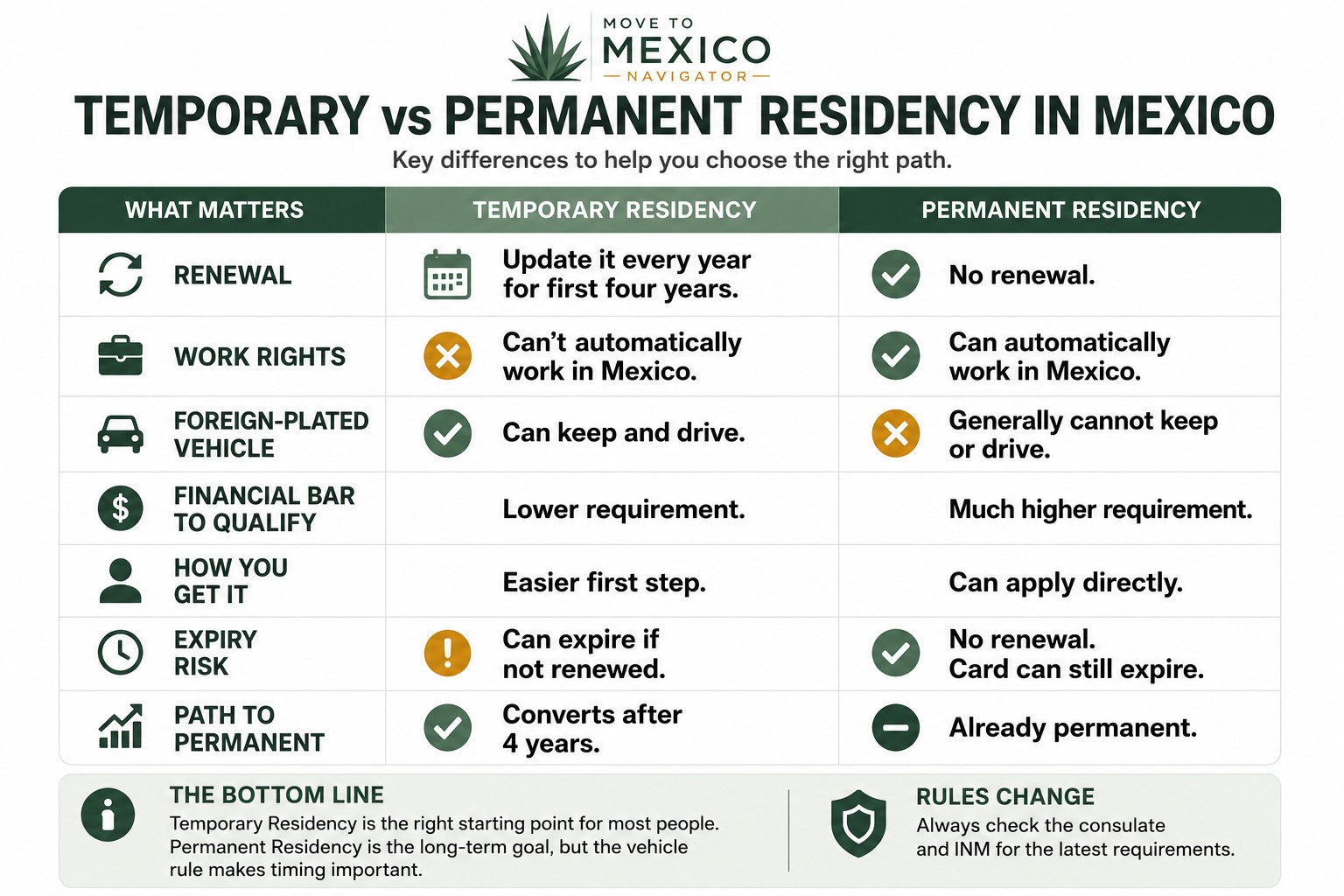
Here's the strategy that matters most. Because direct Permanent Residency has that much higher financial bar, most people can't qualify for it up front. But if you hold Temporary Residency for four consecutive years, you can usually exchange it for Permanent Residency without re-proving your finances at all.
The catch: it is not automatic. You have to file the exchange with INM inside the correct window. If your fourth-year card expires before you file, you can lose that clean path and be back to square one. This is worth marking on a calendar in bright red.
The vehicle trap almost nobody sees coming
People assume Permanent Residency is always the better status. It usually is, with one major exception: foreign-plated vehicles.
Temporary Residents can generally keep a foreign-plated car in Mexico on a Temporary Import Permit. Permanent Residents generally cannot, outside the border Free Zones. That means if you own a foreign-plated vehicle and you jump to Permanent Residency (or convert after four years) without a plan, you can suddenly have a car you can't legally drive. Before choosing Permanent, you need an exit, replacement, or importation plan for that vehicle.
Canje: the step people forget exists
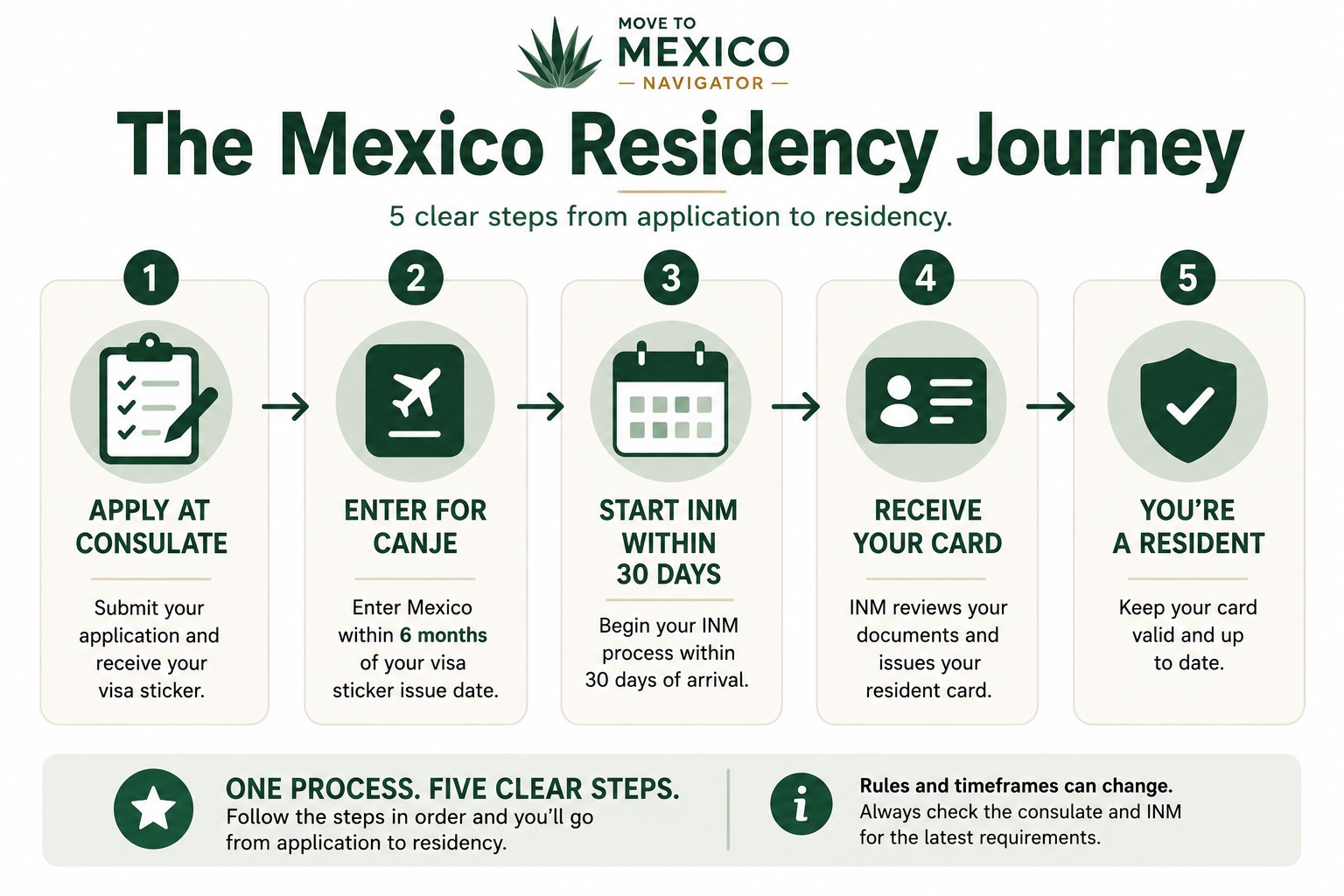
When a consulate approves you, they put a visa sticker in your passport. That sticker is not your residency card. It's essentially permission to enter Mexico and finish the job.
Once you arrive, you complete a process called Canje with INM (Mexico's immigration authority) to get the actual card. A few rules that trip people up: the sticker is generally good for up to 180 days to enter, you must tell the officer you're entering for Canje rather than as a tourist, and you generally have 30 days after arrival to start the INM process. Entering on the automated tourist scanner by mistake can create real problems. This handoff between the consulate abroad and INM in Mexico is where a lot of avoidable stress happens.
Consulates differ, and that's the whole catch
There is no single national rulebook you can rely on. Consulates vary in their financial thresholds, required statement periods, accepted documents, appointment systems, and even which applicants they'll serve based on where you live. A number you found in a Facebook group for one city may be wrong for the consulate you'll actually use.
The specific consulate that serves your area, its exact current thresholds, and whether it accepts applicants from your jurisdiction is precisely the kind of detail you need pinned down for your situation before you book anything.
Where this stops being general
Everything above is the shared map. Your actual route depends on the specifics: your income type and whether it counts, whether Family Unity beats the financial route for you, whether a vehicle changes your calculus, which consulate you fall under and what it currently demands, and how to sequence it all in the right order. Two people with identical bank balances can have very different best paths.
And I'll be honest with you, for some people, the financial bar genuinely isn't met yet, and the useful answer is knowing exactly what it would take to get there rather than being told a comforting maybe. That clarity is the part worth getting right.