

Moving to Mexico With Kids: Schools and Family Life

Moving to Mexico as a single person or a retired couple is one thing. Moving with children is a different project entirely, and it has to be planned around them. The residency and the cost of living matter, but the real question for a family is narrower and harder: can you build a stable daily life here, with a school that fits, a workable commute, healthcare your kids can rely on, and the legal authority to bring them in the first place?
Here's the honest framework, based on what actually trips families up.
Plan school-first, everything else second
For families, this is the rule that changes the whole sequence: school choice drives city choice, then neighborhood, then housing, then budget, then your daily routine. It's the opposite of how most people plan. They fall in love with a city or a rental and then go looking for a school, and that's exactly where it goes wrong.
The single most common family mistake I see is signing a lease because the place looked great online, then discovering afterward that the good schools are across town, the bus route doesn't reach the neighborhood, admissions are closed, or the commute eats two hours a day. Find the school first. Choose the neighborhood around it. Then rent.
This is also where scouting trips go wrong. If you take a trip to check out a city, or even if you're just there on vacation and quietly sizing it up as a future home, and you have kids, go and visit a school. People will tour four rental houses and three neighborhoods and never once set foot on a school campus, even though the school will shape their children's daily life more than any of it. Call ahead, book a visit, walk the halls, meet the admissions staff, ask your questions in person. A school you've actually stood inside tells you more in an hour than a website tells you in a month. Put it on the itinerary the same way you would a house viewing.
And the usual warning applies double for families: a wonderful vacation city is not automatically a good place to raise kids full-time. The daily school run, the healthcare, the commute, and the weather matter far more than the beach once you actually live there.
The school options, honestly

No single school type is best. It depends on your child's age, their Spanish, your budget, the city, and how long you're staying.
Public school can genuinely work, especially for younger children who already speak some Spanish and families planning to integrate locally long-term. It's the most affordable and the most immersive. The catch is that it's Spanish-immersion by definition, parent communication is in Spanish, and it's a hard landing for a teenager with no Spanish.
Local private schools offer more structure and smaller classes without the international price tag, but many are still Spanish-dominant, so verify the actual English support.
Bilingual private schools are the common middle path for foreign families, but see the next section, because "bilingual" is a slippery word.
International schools (IB, American, British curricula) are the safest bet for teenagers, for temporary moves, and for keeping a clean university pathway, but they're expensive, competitive, and mostly clustered in the big cities and major expat hubs.
Homeschool and online school are real, widely used options here, great for trial moves and for protecting a graduating teen's academic continuity, as long as you plan deliberately for socialization and verify how transcripts and re-entry will work.
"Bilingual" is a word you have to interrogate
This is one of the most useful things I can tell you. The term "bilingual" is not standardized in Mexico. At one school it means an English class a few times a week. At another it means several subjects taught in English. At a third it means strong English but native-level Spanish expected everywhere else.
So never take "bilingual" at face value. Ask exactly what percentage of the school day is taught in English, which specific subjects are in English versus Spanish, whether Spanish support for newcomers is included or costs extra, and whether the teachers and administrators can actually communicate with you in English. Two schools with the identical "bilingual" label can be completely different experiences for a child who doesn't yet speak Spanish.
Tuition is not the whole cost
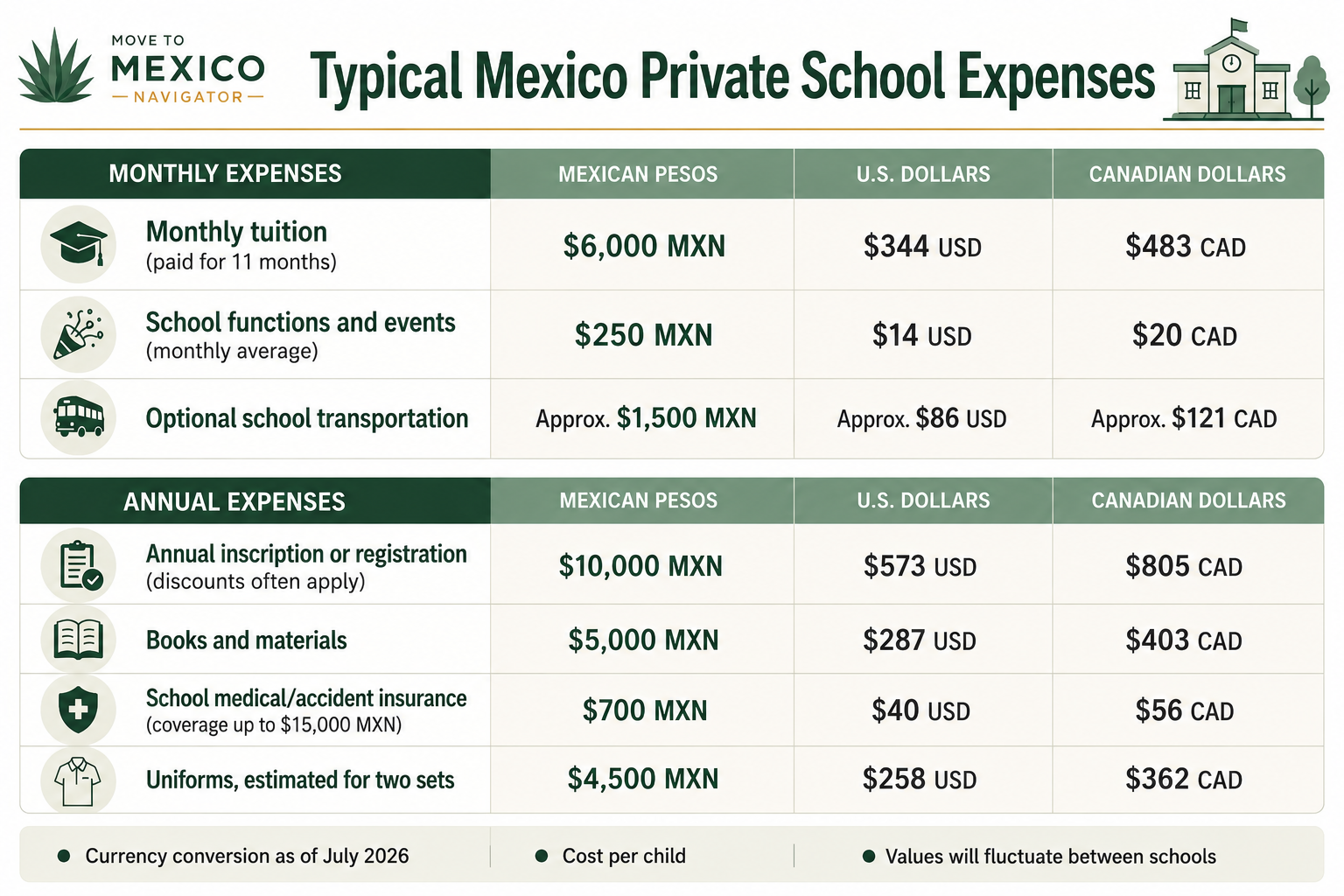
Families consistently underestimate school cost because they look only at the monthly tuition. The real per-child cost also includes an inscription (enrollment) fee, a separate annual re-enrollment fee, uniforms, books and materials, technology fees, the school bus, extracurriculars, and, crucially during the transition, Spanish tutoring. Budget the full annual cost per child, not the headline tuition, or the math on your whole move will be off.
Kids don't just "absorb" Spanish
The comforting myth is that children automatically pick up Spanish. Younger kids often do adapt faster than adults, but it still depends on age, personality, the school's support, and academic pressure, and it is rarely effortless.
It also helps to know there are different Spanishes. A child can be chatting on the playground (social Spanish) long before they can handle an exam in Spanish (academic Spanish), and mistaking the first for the second sets them up to struggle. Watch for the warning signs that a child needs more support: refusing to go to school, stomach aches before school, withdrawal, no friends after a few months, falling grades, or saying they feel stupid. None of these mean the move was wrong. They mean the child needs more support than they're getting, usually tutoring and time.
Age changes everything
Broadly, the younger the child, the lower the academic risk. Toddlers and early-elementary kids usually adapt well with routine and support. The difficulty climbs with age. Middle schoolers feel the social and language pressure hardest. And teenagers, especially those close to graduation, are the genuinely high-risk case, because now credits, transcripts, diploma requirements, accreditation, and university applications are all in play. For a high schooler, verify the credit and diploma pathway before you move, and seriously consider an international or accredited online school, delaying the move, or having one parent relocate first. Uprooting a 16-year-old is a very different decision than moving a 6-year-old.
The legal part nobody wants to think about
I have to be direct about this one because it's serious. If there is another parent in the picture, a custody order, or a shared-parenting agreement, you cannot assume you're legally free to relocate your child internationally. And a travel consent letter is not the same thing as relocation permission, it may get you through an airport without authorizing you to move the child abroad, enroll them in school, or keep them there long-term.
If you're separated or divorced, share custody, or there's any uncertainty about the other parent's consent, get qualified family-law advice before you plan anything else. Immigration eligibility and a school's willingness to enroll your child are not the same as the legal authority to move them.
Kids need their own paperwork, and their own support checks
Two quick but important points. First, your children need their own immigration plan. A parent qualifying for residency does not automatically cover the kids, they need their own applications, cards, and renewals (and minors' permanent resident cards, unlike adults', do need renewing).
Second, if your child has ADHD, autism, dyslexia, anxiety, a speech or learning need, or a medical condition, do not move first and hope the support exists. Verify the specific school support, therapy access, English-speaking specialists, and medication continuity in your target city before you choose it. For a child with real support needs, healthcare and school capacity should drive the city decision ahead of lifestyle.
A school seat is not a social life
One last thing families overlook: enrolling a child in school does not automatically give them belonging. Kids need friends, activities, and routines. Plan for how each child will actually connect, sports, clubs, playdates, homeschool co-ops, neighborhood friends, and be especially careful about moving school-age kids into a heavily retiree-oriented area where there may be no children their age. A child who feels friendless will be unhappy no matter how good the school is on paper.
Questions to ask every school
If you take nothing else practical from this, take these. When you contact a school, ask:
- What percentage of the school day is actually taught in English, and which subjects?
- Do you accept children who arrive with limited Spanish, and is Spanish support included or extra?
- What is the full annual cost per child, including inscription, re-enrollment, uniforms, books, bus, and activities?
- Do you have space in my child's grade, and do you offer a bus to our target neighborhood?
- What support exists for learning needs like ADHD, dyslexia, or anxiety?
- What is the high school or prepa pathway, and if we return to Canada or the US, how portable are the records and credits?
- Can we speak with another foreign parent currently at the school?
Where this stops being general
This is the framework every relocating family needs. What it can't be, on a general page, is your answer, because the right school depends entirely on your child's age, their Spanish, their learning needs, your budget, your city, and which specific schools in that city actually have space, real English instruction, and a workable commute from where you'd live. That last part, matching a real child to real, verified schools in a real neighborhood, is detailed, city-by-city work that has to be done for your family specifically.
And I'll be honest the way I'd want someone to be honest with me: for some families, the timing isn't right, usually because of a teenager mid-way through high school or a custody situation that isn't resolved. Knowing that clearly, before you move, is worth far more than a cheerful "kids are resilient, they'll be fine." Sometimes they are. Sometimes the honest answer is wait a year, and you deserve to hear that too.